JOURNAL
The Longevity Revolution: Has Our Skin Stopped Believing Its Biological Age?
For decades, the skincare industry sold us a war. "Anti-Aging" was the dominant term – a desperate attempt to stop time, erase wrinkles, and fight nature. But in 2026, we understand that this war is over. Not because time has stopped writing its marks, but because we found a way to reprogram the cellular dialogue with the environment. Welcome to the era of epigenetics and Longevity.
The 80/20 of the New Biology: Destiny is Not Written in Stone
The old paradigm claimed that our genetics is destiny. We were born with a specific set of data, and all that was left for us to do was to manage the "wear and tear." Modern science completely shatters this myth: epigenetic studies prove that only about 20% of the aging process is predetermined in our DNA. The remaining 80% is in our hands – or more precisely, in how we "operate" our genes through our lifestyle choices and the active components we introduce into our system.
Our skin is a distinct epigenetic organ. It is the first line of defense that meets the "Exposome" – the sum total of environmental factors, ranging from UV radiation and blue light to the molecular stress of modern life. At LAOR, we do not ask "how do we hide the wrinkle?", but rather "how do we change the genetic expression of the cell so it returns to functioning as it did a decade ago?".
NAD+ and Sirtuins: The Guardians of Longevity
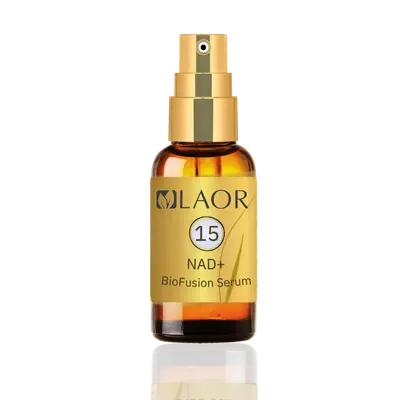
To understand LAOR's breakthrough, we must dive deep into the mitochondria – the powerhouse of the cell. At the heart of this system stands one critical molecule: NAD+. If we think of our cells as supercomputers, NAD+ is the electrical current that powers them. It is the fuel for Sirtuins – a family of proteins known as the "longevity genes", whose job is to repair DNA damage and maintain cellular stability.
The problem is biological: with age, NAD+ levels in the body drop dramatically. When the fuel runs out, Sirtuins go to sleep, and the cell loses its self-repair capacity. LAOR's 2026 formulations do not settle for external hydration; they embed advanced derivatives of NAD+ designed to awaken these mechanisms from their slumber. We do not "give" the skin collagen from the outside as a gesture of mercy; we give the cell the resources to produce it on its own. This is cellular sovereignty at its finest.
From Defect Management to Cellular Optimization
The transition from traditional cosmetics to Skin Bio-hacking requires us to change the language. In the LAOR Journal, we redefine the concept of "perfect skin." It is no longer an expressionless or "frozen" face, but rather skin with high cellular vitality.
This is skin capable of performing Autophagy – a "waste recycling" process where the cell breaks down damaged proteins and converts them into fresh energy. When the skin performs efficient autophagy, the tone becomes clearer and more uniform, silent inflammation (Inflamm-aging) fades away, and the need for external cosmetic coverage decreases. In 2026, The Glow does not come from using a highlighter, but from the optical conductivity of healthy, oxygenated cells treated at the molecular level.
"We are not fighting time – we are learning to dance with it. The goal is to provide the skin with the scientific tools that will allow it to remain relevant, strong, and radiant at any given point on the biological axis." — Ori Laor
The Manifesto of Tomorrow
The vision driving LAOR, under the leadership of Ori Laor, has always aspired to connect the purity of medicinal plants with the cold precision of nanotechnology. This article is a wake-up call for anyone who believes that skincare is a matter of surface area only.
In a world where we can measure our biological age with laboratory accuracy, it is time for our skincare routine to be data-driven and responsible for the future. The path to healthy skin goes through understanding the cell, because ultimately – beauty is just an outward expression of deep cellular health.