JOURNAL
Next-Gen Peptides & Exosomes: The Science of Cellular Communication
The Next Generation of Peptides and Exosomes: The Science Rewriting Skin Cellular Communication
In the past, traditional cosmetics focused primarily on superficial, topical responses: coating the skin in occlusive petrolatum bases, or aggressively exfoliating dead cells to produce a fleeting illusion of freshness. Over the past decade, however, dermatology and molecular engineering have undergone a profound conceptual evolution. Today, we understand that the true key to anti-aging, tissue repair, and skin health lies not in forceful external intervention, but in our ability to converse with the skin in its native biological language: Cellular Communication.
At the epicenter of this revolution stand two groundbreaking technologies: Smart Molecular Peptides and Exosomes.
Over 25 years of developing formulas in the laboratory, I observed how these active complexes fundamentally altered skincare science. They do not merely sit atop the epidermis; they function as "molecular messengers" that deliver precise, direct operational directives straight to the cellular nucleus. In this article, we will deconstruct the fascinating science behind peptides and exosomes, and explore how they harness cellular biology to rewrite the future of your skin.
What Are Smart Signal Peptides and How Do They Work?
To understand peptides—short chains of amino acids—we should imagine them as "molecular keys." The primary structural proteins that grant skin its firmness and elasticity, such as collagen, elastin, and fibronectin, are composed of long protein chains. When dermal collagen naturally degrades due to chronological aging or UV exposure, it fragments into small amino acid clusters. These fragments are peptides.
When a free peptide docks onto specific receptors located on the membrane of a fibroblast (the specialized cell responsible for synthesizing collagen), the cell interprets this signal as a sign that structural collagen has been degraded. It immediately activates an emergency biological cascade: the rapid, mass synthesis of fresh collagen and elastin.
In modern molecular cosmetics, we do not wait for native collagen to degrade. Instead, we engineer Signal Peptides and Carrier Peptides in precise clinical concentrations:
Signal Peptides: Transmit direct cellular instructions to upregulate Collagen I, III, and IV synthesis, effectively thickening the dermal matrix and smoothing deep wrinkles.
Neuro-Inhibitory Peptides: Often referred to as topical "botulinum-mimetic" peptides (such as Argireline). They gently attenuate the intensity of facial micro-contractions, preventing the deepening of expression lines on the forehead and periorbital zone.
Carrier/Repair Peptides (Copper Peptides): Deliver essential trace minerals directly to the cells, promoting tissue repair, calming micro-inflammation, and accelerating cellular DNA recovery.
The Next Frontier: Exosomes—The High-Speed Cellular Postal System
If peptides are the molecular keys, Exosomes represent the most sophisticated biological delivery matrix in existence.
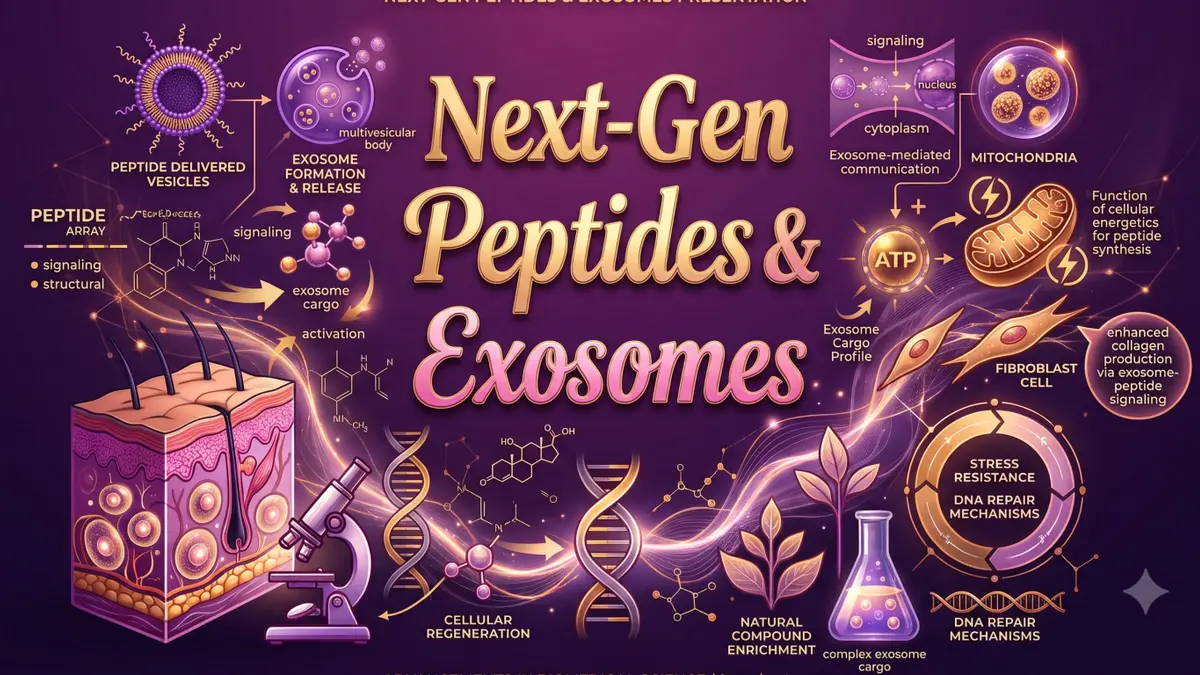
Exosomes are nano-sized lipid vesicles (microscopic spheres ranging from 30 to 150 nanometers) naturally secreted by cells. Their primary biological function is intercellular communication: they encapsulate a rich "information payload" containing microRNA, Growth Factors, peptides, structural proteins, and antioxidants, delivering this payload directly to neighboring or deeper target cells.
The immense clinical advantage of exosomes in advanced skincare stems from three distinct features:
Unrivaled Transdermal Penetration: Due to their nanometric scale and lipid membrane structure, exosomes easily cross the epidermal barrier (bypassing the traditional 500-Dalton constraint).
Protecting Active Cargo: Their protective lipid shell shields fragile growth factors and RNA from enzymatic degradation, bringing active molecules in their purest form directly into the cell cytoplasm.
Reactivating Dormant Cells: When an exosome fuses with an aging or fatigued fibroblast, it releases its biological cargo into the cell. The cell receives an immediate "software upgrade," awakening to synthesize proteins and repair matrix damage just like a youthful cell.
Molecular Synergy: Peptides, Exosomes, and Mesotherapy
To extract maximum efficacy from cellular communication technology, relying on a single ingredient is insufficient. We must engineer a synergy between mechanical and chemical pathways:
Creating Transdermal Channels (Mesotherapy / Derma Roller): Generating microscopic channels in the stratum corneum increases the absorption and penetration capacity of exosomes and peptides by hundreds of percent, allowing them direct access to the living dermis.
Flooding Cells with Molecular Signals: Infusing active serums loaded with multi-dimensional peptide complexes and exosomes. Cells receive the biological green light to ramp up collagen synthesis and repair the extracellular matrix.
Sealing with a Ceramide Envelope: Layering a rich moisturizer that locks in active compounds, restores the epidermal lipid barrier, and ensures intercellular signaling occurs within a protected, calm environment.
Integrating Cellular Communication into the Layering Methodology (LayerSystem7)
The science of peptides and exosomes is seamlessly deployed through a physiological layering protocol:
Physiological Cleansing: Washing the face with a gentle, pH-balanced cleanser to prepare the cell membrane to receive molecular signals.
Deep Cellular Communication Layer (Serums): Applying a molecular serum packed with signal peptides, multi-weight hyaluronic acid, and exosomes. This layer penetrates deep into dermal tissue, delivering cellular renewal commands.
Locking & Fortifying Layer (Nourishing Creams): Layering a day or night cream rich in ceramides and essential fatty acids. This layer shields exosomes and peptides, halts transepidermal water loss (TEWL), and completes the therapeutic architecture.
Conclusion
Molecular peptides and exosomes are far from passing trends; they represent the future of aesthetic medicine and advanced scientific dermatology. When we stop assaulting the skin and elevate our dialogue with cells using precise molecular language—the tissue responds with breathtaking rejuvenation, remarkable firmness, and enduring vitality.