JOURNAL
Sugar Damage & Skin Glycation: The Science of AGEs & Collagen Rigidity
The Science of Sugar Skin Damage: How to Halt the Glycation Process (AGEs)
When discussing factors accelerating skin aging, most consumers instantly recall solar UV radiation or urban air pollution. Yet in recent years, molecular dermatology has exposed an internal, silent, and progressive enemy operating within our bodies every day: Glycation.
Have you ever wondered why, with advancing age, the skin loses its firm rebound elasticity, takes on a dull yellowish cast, and exhibits deep, rigid wrinkles that fail to respond to conventional moisturizers?
The clinical answer lies in the chemical interaction between excess circulating sugars (glucose and fructose) and structural skin proteins. Frequent searches for "how sugar affects facial skin" show that awareness of sugar damage is at an all-time high. Over 25 years of formulation development, I learned that glycation is one of the most destructive mechanisms to collagen, yet through targeted molecular nutrition—it can be effectively inhibited. In this article, we will deconstruct the chemistry of glycation and reveal how to maintain elastic, youthful collagen.
What Is Glycation and How Does It Damage Skin Architecture?
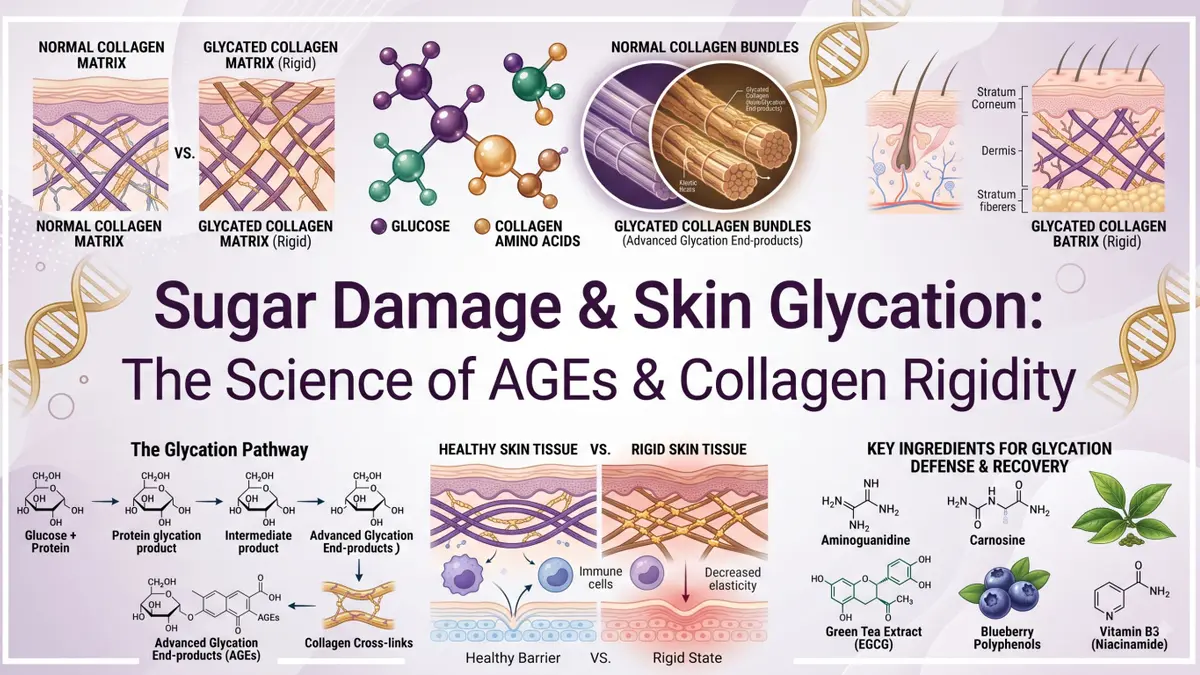
Glycation is a non-enzymatic chemical reaction where free sugar molecules in the bloodstream bind irreversibly to structural proteins—primarily Collagen and Elastin.
When a sugar molecule attaches to a collagen fiber, it triggers a cascade yielding destructive compounds known as AGEs (Advanced Glycation End-products).
The accumulation of AGEs causes damage across three clinical dimensions:
Collagen Rigidity & Brittle Matrix: Healthy collagen fibers are supple, elastic, and pliable. Glycation cross-links these fibers, hardening them until they lose their capacity to stretch. The outcome is skin prone to deep creasing, sagging, and structural collapse.
Impaired Cellular Renewal: Dermal fibroblasts are unable to adhere effectively to glycated collagen. The synthesis rate of fresh collagen plummets, leading to loss of natural facial volume.
Sallow, Yellowish Complexion: AGEs possess a characteristic brownish-yellow hue. Their accumulation in the dermal layer imparts a dull, fatigued, and sallow appearance to the skin.
The Molecular Solution: Anti-Glycation Actives & Elasticity Protection
To halt glycation and shield structural collagen, advanced molecular formulas integrate active complexes functioning as "molecular shields":
Targeted Anti-Glycation Actives: Utilizing botanical and molecular compounds (such as Alpha-Lipoic Acid, Niacinamide, Green Tea Polyphenols, and Carnosine). These actives compete with structural proteins, binding free sugars before they touch collagen, thereby neutralizing AGE formation.
Potent Antioxidants: Glycation is intrinsically linked with elevated oxidative stress. High-potency antioxidants like stable Vitamin C, Vitamin E, and Glutathione halt the oxidation cascade and preserve dermal stability.
Stimulating Fresh Collagen Synthesis (Signal Peptides): Infusing signal peptides to upregulate the synthesis of fresh, flexible, non-glycated collagen fibers to replace damaged structures.
The Anti-Glycation Layering Protocol
Physiological Cleansing: Washing with a pH-balanced cleanser to strip surface impurities.
Molecular Anti-Glycation Serum (Deep Dermis): Infusing a serum rich in Niacinamide, signal peptides, Vitamin C, and antioxidants operating in the deep dermis to prevent AGE cross-linking.
Locking & Lipid Replenishment: Sealing with a rich moisturizer formulated with skin-identical ceramides and cold-pressed botanical lipids to preserve tissue elasticity.